


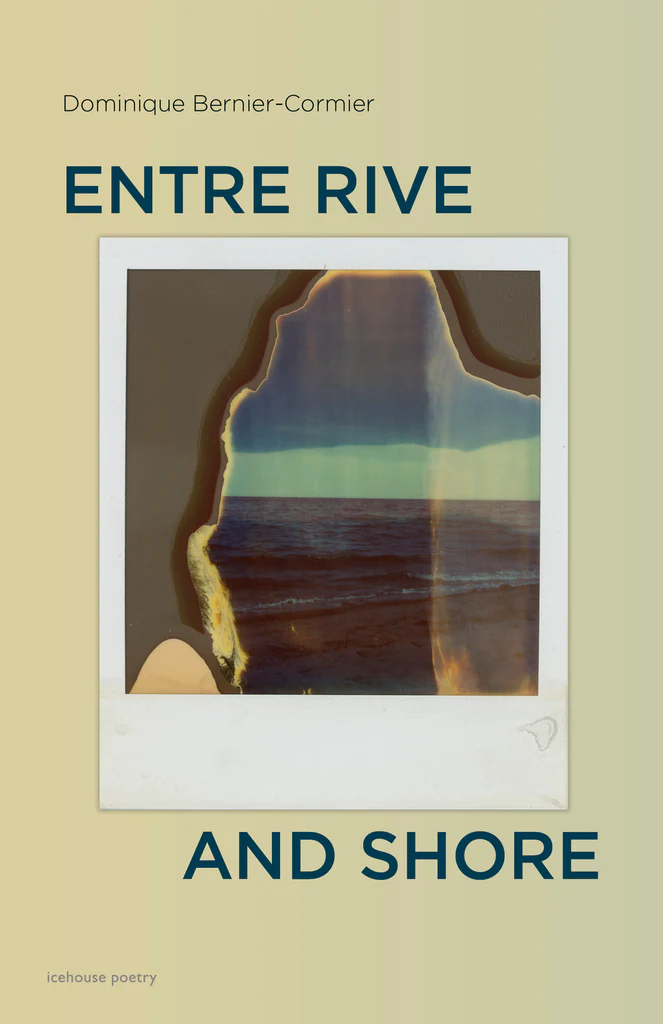
When i read the first few pages of Dominique Bernier-Cormier’s Entre Rive and Shore i was curious about his story, finding his way to Louisiana as an Acadian descendant. Somewhere along that journey i was completely spell-bound with his play of words between languages in such a vulnerable way. He was sharing questions i, too, grapple with, pained by loss of language. i was eager to share in conversation with him. Here is part of our transcript.
s: This poetry collection is more than an Acadian road trip in Louisiana discussing translation: this was a very personal account about the reverberations of loss and identity. These themes i, myself, have deep connection to. What was that process like with your father and how did you decide what to put in the book and what to just leave private?
D: From the beginning he was very open. He’s a journalist and he’s used to being in the public sphere. I’ve learned so much from him about relationship to language. And I think I’ve taught him too. I think we’ve each changed each other’s relationship to French and English. That’s what I like about these kinds of writing projects: it wasn’t a collection of poems, but a journey. I had no idea what I was going to find in Louisiana and I had no idea that my Dad was going to write this letter. Every time something new happened it changed the direction and shape of the book. It feels very much like a record of five years of thinking and talking about these issues with my family, with Acadian people and with Francophone communities.
s: Writing in our cultural languages requires much consideration about how much is translated for the dominant-language readers. Why did you choose to not translate everything or add footnotes?
D: I have to give a shout out to Klara du Plessis, who writes poems with Afrikaans in them and does not translate it until the very end of the book. Reading Klara’s first book Ekke was really the inspiration. I thought, “I want to do that, I want to be brave enough to let people not necessarily understand everything.” Especially in a genre like poetry, where so much is already ambiguous, I think there’s space for that linguistic ambiguity. I think it’s good to destabilize, decentralize English in that way, to give dominant-language readers that feeling that not everything is necessarily accessible to them. But also, from the beginning, this book was written with bilingual readers in mind, and even more specifically for an Acadian readership who lives that bilingual reality every day.
All my life the discourse around French has been that it’s fragile, that we’re losing it. I think it’s all right to acknowledge that, but it’s also important for me to put language vulnerability into perspective, especially regarding the state of many Indigenous languages in Canada. French, here, can handle being mixed with English in these ways. It was a bit different in Louisiana, though. In Louisiana you felt the fragility, the grief of language loss. My generation’s grandparents were the ones who spoke French, but the parents weren’t allowed to speak French at school. So this current generation, my generation, are the ones feeling that loss. It was a very palpable absence.
s: i can imagine what you mean. i feel it. i want to tell you how more dire it has been for most Indigenous languages and families, but cultural grief is grief. We all lose so much when we shut each other out, when we ask people to be the same. So many individuals and groups of people have been hurt along the way. i feel like kin in your story. It has touched me. i still worry about the ability of the L’nu (Mi’kmaw) language to fully recover, but i’m living that reclamation work in almost all that i do, including in my poetry.
D: That’s why I don’t feel we can talk about languages without talking about their historical context and power dynamics. Languages are living things that can exert power over each other. The relationship between French and English is not the relationship between Mi’kmaw and English. Historically, colonially, it’s not the same. For me, part of that freedom in mixing French and English comes from my understanding that the primary relationship of power is not a fight between French and English. The larger power dynamic is between colonial languages and Indigenous languages. I’m lucky that French is very healthy in my community and in my life.
s: i loved following your thought process and journey. i became fascinated with the concept of “crossing over” between languages. The Mi’kmaw language is verb-based and polysynthetic (longer words with many word parts, and fluid word order), as you probably know. French and English are both noun-based and inflected (shorter words in specific word order). These are just different linguistic forms of language creation. Reading your work i realized that you can more easily blend French and English; it is more complex to do that with Mi’kmaw and yet i had been trying. Des fois, it feels more daunting to traverser à la rive Mi’kmaw. C’est peut-être plus difficile pour moi de continuer à nager. i am inspired to focus-in on the verb part of this concept, the “crossing over,” imagining being in water of mixed currents and landscapes.
D: I think that’s the thing. Languages are supposed to meet each other, and languages are supposed to influence each other. They are supposed to exchange and to be a site of sharing: I think because of the colonial context it hasn’t been that way. It’s been violent and destructive to languages. Languages meeting should be a fertile, beautiful, productive thing. We always talk about what’s lost in translation but what is gained in translation? What is gained in the interplay and in talking about how to say things in different languages? That’s what I’m interested in. That’s what’s beautiful.
My metaphor about crossing over is also about transplanting: taking seeds or plants from one place to another. I wanted to explore this idea: can a language grow in a different geographical place?
s: i appreciate following your journey and at the end you find a peace. That’s how i write too. i go through some of the turbulence of this pain of what is lost or the challenge of today but then i always find a way to say to myself: we can heal from here. What is your message to readers?
D: For me it was important to end on hybridity and on looking forward. The last poem is called “Vision” and it’s a fully bilingual poem. I think of it as one of my most successful attempt at fully integrating French and English. I wanted to end with the idea that the relationship between languages should be a positive force going forward, into the future. I hope our languages can co-exist, influence each other in a way that enriches instead of dividing us. Instead of those relationships creating conflict inside of us, I hope we can see the beauty and potential in them.
Written By:


Win Your Classroom Wishlist
Stay tuned for our next contest for Atlantic Canadian teachers! In the meantime, build a wishlist of books in the ABC collection that you can shop from any time! We'll let you know when it's time to share on social media with the hashtag #ReadAtlanticABC for a chance to win books from your list (up to $250 value).

