


Look up, look around: Examining the natural world
by Meg Edwards
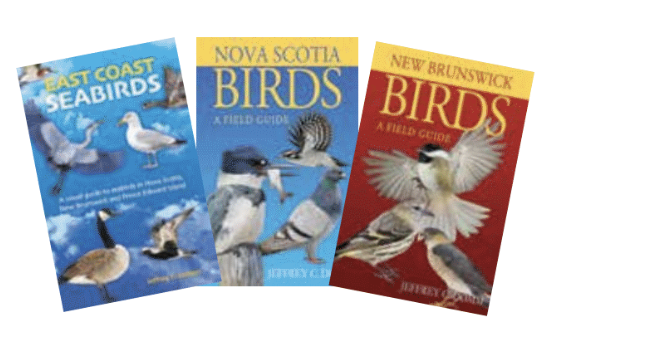
Most of us have our eyes glued to a bright screen for much of the day, and sadly that holds true for children too. While our eyes glaze over and our minds grow numb, the living, natural world is swirling magically around us, unnoticed. No matter whether you are on a busy city street or in a quiet backyard, if you look up from your phone you will find life. Birds are singing, insects creeping and animals, their every sense alert to our presence, are hunting, foraging, nesting and living their lives practically underfoot. Jeffrey C. Domm, an award-winning wildlife and nature illustrator (and retired instructor at NSCAD) with over 30 published books, hopes that his work encourages readers “to take the time to explore and take a walk in nature.”
As a child, Domm was a nature lover who loved to draw but it took him some years to put the two together. He had been working as a filmmaker and a designer when, after his first child, he found himself at the Robert Bateman Gallery and realized that he “wanted to get back to his art.” His first book (which never ended up being published) was about inner-city wildlife, the creatures that live alongside humans in the cities.
Now, in a full circle moment, Domm is in the middle of creating a new book about the same subject, urban wildlife. In this book (set to be published in late fall) he will guide families on how to reclaim the wild in their own backyards. With easy DIY projects included, this book will teach how you can make your garden more habitable to the wild creatures who live there or pass through.
Domm takes great pride in the realism of his illustrations. At one point when he was working on a guidebook about fossils, rocks and minerals, someone working on the book suggested that it would be easier and better to use photographs to capture the difference in textures.
Domm knew he had to prove he could do it. Later, when he pulled out his illustrations the man responded with,“That’s it! That’s why I said we needed to illustrate in photographs!” Domm, whose illustrations are truly as detailed and precise as photos, said he proudly “packed and up walked away.”
Domm has found that the distinction between adult and young readers is blurred in his field. At first, he was surprised to find children turning up to his shows asking him to sign adult birding books, but after he began to create books specifically for children, he found that adults turned up at the children’s events! It turns out that bright, beautifully designed guidebooks with clear definitions and check lists are popular with young and old.
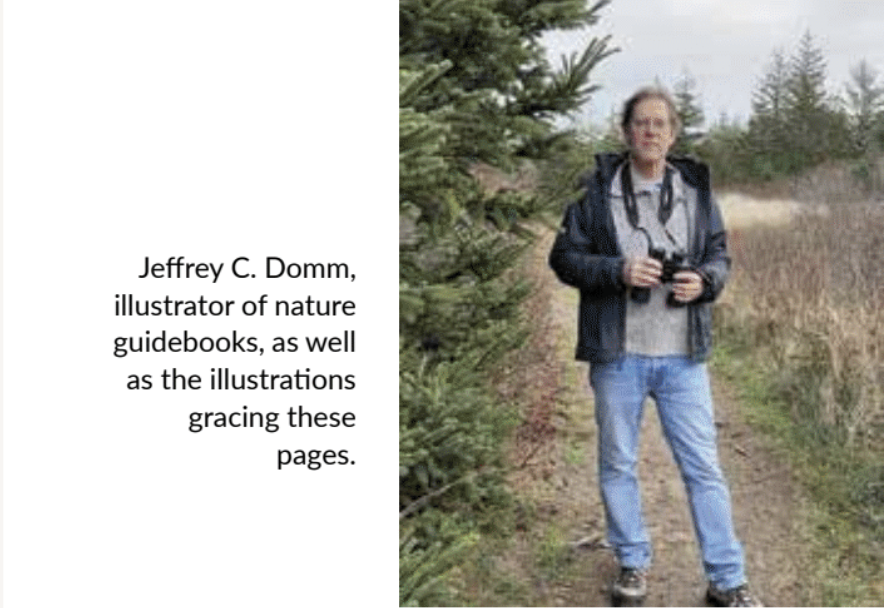
Today, Domm is grateful that he has been able to spread his vision to so many people, no matter what their age. “The books connect them (the readers) to nature,” says Domm, “and that’s what these books are designed to do.”
Giving a child an illustrated book of their own is agreat way to interest them in the natural world and Peggy Kochanoff’s Be a Close-Up Nature Detective: Solving theTiniest Mysteries of the Natural World (Nimbus Publishing) is an excellent book for encouraging young naturalists.
Kochanoff concentrates on three habitats—a tree, a beach and a log. Her delicate watercolour illustrations begin with a wide view and then move in, as if with a microscope, fora closer look. Bright little sticky notes with a 3D effect add extra information to the page in an eye-catching manner.
This lovely book is full of fascinating details. Did you know that starfish have a small red eye at the tip of each arm? There are many interesting tidbits throughout the book, such as how to identify where a deer ate a branch or how ferns reproduce with spores, not seeds.
Sarah Grindler’s Ocean Secrets: A Guidebook for Little Underwater Adventurers (Nimbus Publishing) is another great book to grab for children heading into their summer vacation. This little book is bright and colourful and packed full of information in short easy-to-read sections.
Grindler even explains how the moon causes the ocean’s tides to rise and fall so that she can describe an intertidal zone and the creatures that live there. The young reader can then study a beautiful double-page illustration of a pool in the intertidal zone and try to spot the creatures.
The reader will also be introduced to the “twilight zone”where bioluminescent creatures stand out brightly against the dark blue sea, and the deepest darkest “abyssal zone” where odd creatures like the blobfish live. And here is a surprising fact: did you know that most creatures, no matter how far down they live, travel up to the ocean’s surface at night for a midnight snack?
According to Domm, it is the visuals that help people connect with nature. And once we start looking, and actually seeing, we are on our way to caring, protecting and preserving. ■
MEG D. EDWARDS is a writer living in Baie Verte, NB. She writes plays and poetry, and her personal essays can be readon her blog, Notes from a Sinking Isthmu.
Written By:


Win Your Classroom Wishlist
Stay tuned for our next contest for Atlantic Canadian teachers! In the meantime, build a wishlist of books in the ABC collection that you can shop from any time! We'll let you know when it's time to share on social media with the hashtag #ReadAtlanticABC for a chance to win books from your list (up to $250 value).

