


‘Intergalactic’ torpedoes and ancient shark cannibals swarm ‘In Search of the Great Canadian Shark’
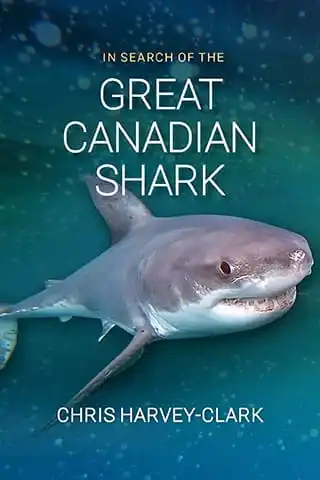
We asked seasick marine-biologist turned journalist Cassie Williams to review Chris Harvey-Clark’s In Search of the Great Canadian Shark
If you suffer from thalassaphobia, an intense fear of deep water, this one may not be for you. Chris Harvey-Clark details some incredible, sometimes terrifying, adventures and interactions with unique and straight up bizarre species in the waters off Canada in his latest book, In Search of the Great Canadian Shark.
From an early age, Harvey-Clark says he was fascinated by the deep and the creatures who dwell within. In this book, the research veterinarian and marine biologist based at Dalhousie University takes you below the surface of Canada’s oceans, which are home to a cadre of weird and wonderful creatures.
For as long as I can remember, my first question when seeing a large body of water was always, do you think there are sharks in here? From an early age, maybe too early, the movie Jaws came to define my love and fear of the water.
Reading through Harvey-Clark’s book, I can’t say I’m any braver at the thought of being alone in the often murky depths around Nova Scotia.
One of the more fascinating and bizarre species in Maritime waters is something called a torpedo ray. Picture a cross between a shark and a ray. “They looked like a huge flattened ray built for intergalactic travel,” Harvey-Clark writes.
He describes the way in which they wrap their body discs around prey in a deadly hug, emitting electric shocks somewhat akin to sticking your finger in an electrical socket. They’re also sensitive to electrical stimuli in the water, occasionally making a run at unsuspecting divers behind the flashing lights of a GoPro.
In other dives, Harvey-Clark describes his experience swimming “eyeball to eyeball” with one of the longest-lived and most mysterious shark species on Earth, the Greenland shark: a species so ancient, individuals swimming in our oceans right now could be 250 to more than 500 years old. It’s a voracious cannibal that only reaches maturity at the ripe old age of 150.
On a first interaction with a Greenland shark off the dock in Baie St. Pancrace, Que., he writes: “As a scientist, when you have spent half a decade looking for a rare animal and have come to the conclusion you will likely never find it, to then suddenly encounter the living creature face to face is a life-defining moment. When the animal is a thirteen-foot shark, ghoulish in appearance, and you have no idea whether it wants to eat you, there is a certain edginess in that moment.”
It’s one of the many instances reading the book you wonder how Harvey-Clark has kept all his limbs intact.
Until more recently, so-called man-eating sharks weren’t usually on the radar for Atlantic Canadians, but with the recent work of organizations like Ocearch, tagging numerous great whites off our coast and even a great white shark diving company setting up shop, it’s hard to ignore their seemingly increasing presence. In fact, the Nova Scotia government recently announced it would place signs at a dozen beaches warning people the large predators are indeed in Nova Scotia waters.
Growing up in landlocked Ontario, my first exposure to the sea was on the beaches along the freezing Labrador current where my grandparents lived, in Placentia Bay, N.L..
We’d make the days-long drive in a cramped 1986 Honda Civic hatchback. Two stressed out parents, and my sister and I brawling in the back with a pillow acting as a blocker between feet and fists.
It was always such a relief to reach North Sydney, waiting to board the ferry across the Cabot Strait. Once aboard I’d spend most of the time out on deck, partially because of seasickness, but mostly to stare for hours at the blue, nearly black water and daydream of long extinct megalodons pursuing us.
Reading about Harvey-Clark’s many incredible adventures in and on the water reminds me of why I pursued marine biology in the first place and why – after a few close calls of my own – I decided to pursue a career on dry land.
Written By:


Win Your Classroom Wishlist
Stay tuned for our next contest for Atlantic Canadian teachers! In the meantime, build a wishlist of books in the ABC collection that you can shop from any time! We'll let you know when it's time to share on social media with the hashtag #ReadAtlanticABC for a chance to win books from your list (up to $250 value).

