


How Nova Scotia folk art went from ‘foolishness’ to foundational
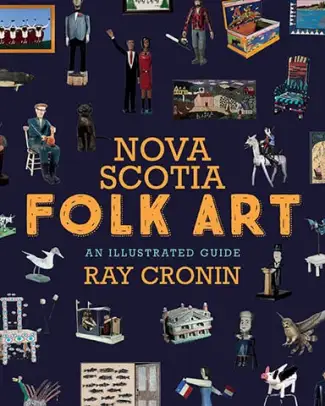
Nova Scotia Folk Art: An Illustrated Guide , reviewed by Audrey Sandford of Black Sheep Gallery
Nova Scotia Folk Art: An Illustrated Guide by Ray Cronin is a very readable book. As with his earlier book on Maud Lewis, Mr. Cronin displays a unique ability to pack a lot of information into very little space, using pictures and text in a skillfully casual manner. Given his depth of experience in the art world, and his lengthy exposure to Maritime Canadian art in particular, one might expect a more scholarly, detailed approach to his subject; this book is anything but.
The author has artfully incorporated the information from several previous books on Nova Scotia folk art, brought it all up to date, and given us both an enjoyable read and an excellent research book which will be embraced by anyone dipping their toes into the folk art genre. While many of the artists featured in this book have passed away, Mr. Cronin has also given us a peek at a few current artists who continue the work on a level equivalent to, or almost equivalent to, the established “old guard” artists discovered by Chris Huntington in the early 1970s.
The book is divided into three sections, and the first section, featuring the “first wave” of artists discovered in the early 1970s, is perhaps the most interesting. These are all artists whose work has been consistently held up as exceptional for six decades and has had significant influence on the art community across Canada. For example, the Art Gallery of Nova Scotia is affectionately referred to as “the house that Maud built.” A painting by Maud Lewis sold for in excess of $400,000 at an auction in 2022 and her paintings regularly sell for five figures at auction today. Both Maud Lewis and Joseph Norris have had solo exhibitions which toured Canada, and a selection of Nova Scotia folk art toured the United Kingdom in 1989.
At the time the “first wave” of artists featured in this book were creating these works of art, with little encouragement or direction, work in rural Nova Scotia was primarily limited to fishing and logging and both of these lines of work were spotty. Several of these “first wave” of artists could not read or write and this made life even harsher. Any effort expended on endeavours that did not result in something functional was considered “foolishness,” a word often heard by Chris Huntington when he offered money for their work.
Loud joy or quiet desperation?
This was no doubt reflecting the comments heard by the artists from family and friends who simply could not understand why they were not putting their efforts into making something more functional. There was certainly no market for their work, but they forged ahead with their creations nonetheless.
When one reflects on the circumstances in which these artists lived and created, one is reminded of Henry David Thoreau’s comment that, “The mass of men live lives of quiet desperation.”
Not these men and women.
Despite the conditions in which they found themselves, and with little support or recognition, they had something to express, and express it they did.
Because my husband and I did not start collecting folk art, and primarily Nova Scotia folk art, until the mid-1980s, the only artist listed in the first category we had the opportunity to visit was Bubby Mooers, and we spent many pleasant afternoons at his home in Milton, Nova Scotia.
We did have the privilege of visiting with many of the artists in the book’s “second wave” over the years, including Phyllis Cosman, Murray Gallant, Eddie Mandaggio, Garnet McPhail, William Roach, Stanley Rector, the Naugler brothers, Leo, Ransford and Bradford, and David Stephens, and take lots of pictures and video. Some of the video can be seen on the artists’ page on our website.
In our opinion, Mr. Cronin’s selection of “third wave” artists is bang on. We are pleased to be good friends with Scott Higgins and Barry Colpitts, who are included in this category, and have little doubt that their work, like that of the others described in this book, will endure. Buy this book!
The Black Sheep Gallery was opened in 2000 and it is situated in a converted 1,200 square foot fish plant on the shore of Jeddore Harbour, N.S. The work of over 40 Nova Scotia folk artists past and present are featured, as well as a selection of folk art from Ontario and Quebec.
Written By:


Win Your Classroom Wishlist
Stay tuned for our next contest for Atlantic Canadian teachers! In the meantime, build a wishlist of books in the ABC collection that you can shop from any time! We'll let you know when it's time to share on social media with the hashtag #ReadAtlanticABC for a chance to win books from your list (up to $250 value).

