


From a different angle: Acadian publishing house Éditions Perce-Neige boldly celebrates 45 years
by Jo-Anne Elder
There is much for Éditions Perce-Neige to celebrate this year. An essential feature in the Acadian literary landscape since 1980, Perce-Neige is marking its 45th anniversary. The publisher is at a turning point and is viewing and showing Acadie “from a different angle.” Recent changes reflect Acadian literature in the second decade of the millennium in bold and surprising forms and contents. As part of new graphic, web and cover design, the text on this season’s covers is printed vertically. Another literal new direction is the impressive 2025 team. Perce-Neige began as a collective of four of Acadie’s leading poets, succeeded by Gérald Leblanc and then Serge Patrice Thibodeau (1990-2005 as managing editor, 2005-2023 as managing and literary editor). The house is now under the direction of Danielle LeBlanc, Managing Editor for the past year; Émile Turmel, Literary and Art Editor since 2023 and Catherine Pion, in charge of marketing.
This is not the first time that women have played a pioneer role in Perce-Neige. Poet Dyane Léger inaugurated its list in 1980 with her poetry collection Graines de fée, and Rose Després’s publications have figured prominently since 1982. These pre-eminent feminist poets broke with one of the traditions established by the first French-language publishing house in New Brunswick, Éditions d’Acadie (1972-2000), which introduced Raymond Guy LeBlanc, Guy Arsenault and Herménégilde Chiasson. These poets of the “tenth renaissance” asserted Acadie’s modernity, collective identity and the first inscription of non-standard language. Less than ten years later, Perce-Neige affirmed a more urban and more introspective view, and has highlighted the diversity of writers(Queer and Indigenous) and Acadian / Cadien regions. While Éditions d’Acadie inscribed Acadian literature into history, Éditions Perce-Neige’s work is what Jonathan Roy calls a “désincriptionalisation,” a neologism I might translate as a process of “unsubscribing” to official narratives and outsider views of language, literature and identity.
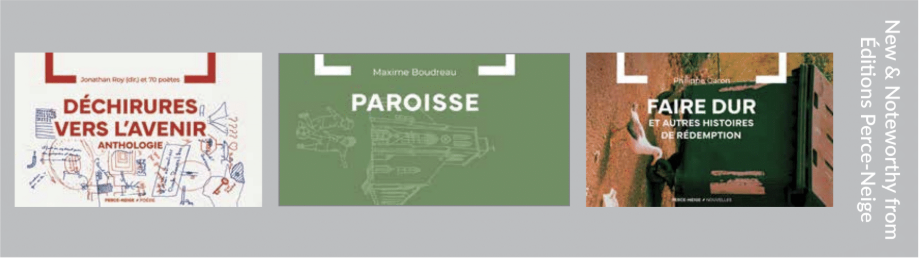
Déchirures vers l’avenir, the anthology Jonathan Roy edited for the 45th anniversary, is a scrapbook, a living collage that reveals passions and dissidences, tribute and irreverence, and the intersectional identities of Acadie. Like the vertical title on the cover, the format is unexpected. The book is divided into five “collections” named by a line or two by a different poet about a different struggle. The table of contents presents poems by title only and the index of (70!) authors is alphabetical by first name, from André Muise to Zachary Richard. Jonathan Roy presents an Acadie that is “more dynamic, more convivial, unscripted” and hopes that his peers will see themselves in these ruptures / cuttings / heartbreaks that move towards the future, always in progress. Roy’s introduction, written in a French with inflections borrowed from the spoken language of northeastern New Brunswick, sets the tone for a lively conversation in which poets talk over each other, contradict each other, refer to each other and finish each other’s sentences.

In 2018, Serge Patrice Thibodeau, then publisher, asked Roy to compile a poetry anthology that would mark the passage into the third decade of the 21st century. As Roy delved into the publications, a theme “imposed itself”: “revolt in all its forms, rebellion, protest, indignation…” The poets featured in the collection span nearly 50 years of Acadian writing, and the editor’s viewpoint is that of an insider and a Millennial. Jonathan Roy writes and works in a different literary and arts scene from that of the Baby Boom founders of publishing houses, theatres, musical groups and book fairs. In the 70s and 80s, small groups of students from arts disciplines formed co-ops that quickly became Acadian institutions, advocating for francophone artists and citizens. The 21st century has seen recession and inflation, Quebec student protests and Covid, and terrorism and tumult. Arts funding is more precarious, postcolonial identities fragment and consolidate and independent tools of production are more available. This anthology shows that literature isa compelling witness to change and a powerful change-maker.
The oldest French-language book fair in New Brunswick, in Madawaska, awarded Perce-Neige its Prix du salon this year. Performances and events are planned throughout the year, including the Frye Festival, the Quatre jeudis series in Barachois and the Acadian Poetry Festival in Caraquet. No doubt, there will be surprising, challenging and inspiring discoveries for readers.■
JO-ANNE ELDER has translated more than 20 works of poetry, theatre, film, fiction and non-fiction from French to English and has been shortlisted fora Governor General’s Literary Award for translation three times.
Written By:


Win Your Classroom Wishlist
Stay tuned for our next contest for Atlantic Canadian teachers! In the meantime, build a wishlist of books in the ABC collection that you can shop from any time! We'll let you know when it's time to share on social media with the hashtag #ReadAtlanticABC for a chance to win books from your list (up to $250 value).

