


Breaking Paths on the Rock: Q&A with Dr. Margot I Duley
By Carol Bruneau
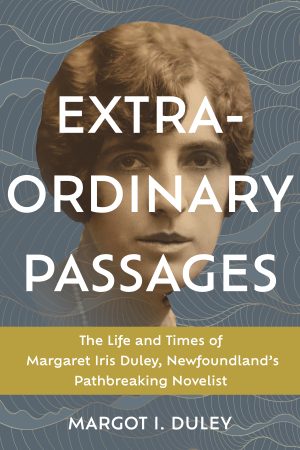
Extraordinary Passages: The Life and Times of Margaret Iris Duley, Newfoundland’s Pathbreaking Novelist is the extraordinary story of Newfoundland’s first internationally renowned novelist interwoven with the history of women’s rights during tumultuous years. Historian Dr. Margot Duley, Margaret’s niece, is a feminist scholar and Dean Emerita at the University of Illinois. Born, raised, and now living in St. John’s, she follows in her aunt’s footsteps, blending erudition and a gift for crafting a riveting story. Margaret Duley (1894-1968) published four novels which, in her day, enjoyed wide acclaim. She rubbed shoulders with literary stars in London and New York. Drawing on her elite upbringing in St. John’s and knowledge of outport life, her books reflect the complexities of Newfoundland’s colonial society and a commitment to bettering women’s lives from Edwardian times to the province’s joining Confederation. Margot Duley’s biography provides intimate insights into the shaping of a writer who never let church, empire, and patriarchy dampen her feminist, antiwar spirit or the quest for enlightenment to discern her life’s “pattern.” It underscores the impact of both world wars on the novelist, which, along with deep reading and unusual spiritual pursuits, informed Margaret’s writing as much as these events shaped Newfoundland’s postcolonial identity. |
CB: What was it like bringing your aunt to life?
MD: I had a truly wonderful time. As I reread her novels, I’d think, “There she is!” This was especially true in her hilarious social satires and equally in the lyrical and mystical passages in Highway to Valour (1941). Remembering her decline from Parkinson’s dementia was difficult, plus researching World War One through her eyes and realizing how deeply it affected her and the family. But overall, it was an absolute delight to spend time with my aunt. She could be formidable but always entertaining and she always encouraged me. I think it helps that I went into history. If I’d tackled a novel, it would have been a lot to live up to.
CB: Most but not all Margaret’s ideas were ahead of their time. How was it viewing her and other family members critically?
MD: Historians routinely struggle with critical distance especially when it’s the recent past. You can’t judge people by the viewpoints of your own age. I struggled most with Margaret’s mother Tryphena who was a very conservative maternal feminist. Tryphena was harsh on her very achieving daughter. I’d read things she wrote and gasp, but I had to enter her Victorian evangelical world and see how it shaped her. Eventually I depicted a clash of generations and tried to present a rounded picture of them both. Margaret’s failings were easier to do. She was quite self-revealing. Novelty on Earth (1943), her novel about adultery, is a wellcrafted, psychologically nuanced confessional.
CB: Why isn’t Margaret’s work better known today, like that of her era’s male writers, including fellow Newfoundlander E.J. Pratt?
MD: She certainly encountered discrimination in her day. If Ellen Elliot at Macmillan, the first woman to hold a senior position in Canadian publishing, hadn’t championed her, I don’t think Margaret would have been published in Canada. However, there’s a continuing problem about how to integrate pre-Confederation Newfoundland into Canadian Studies. Plus, her novels can’t be categorized neatly. Her first, Eyes of the Gull (1936), is a Gothic novel. The second, Cold Pastoral (1939), though set in the 1930s, uses Romantic conventions, while Novelty on Earth is a very modern novel. She also experimented with her writing style. Highway to Valour is at turns hilarious, moving, mystical, and exquisitely phrased, while Novelty is smart and breezy and reads like a stage script. What is consistent is the quality of her writing, especially her evocative seascapes and her ability to capture the essence of a character in a few telling phrases. I hope some bright academic or editor will come to terms with this. She was a marvelous writer.
CB: She wrote for radio and continued to write short stories well into her illness, but her years of international fame were short. Did refusing to compromise play a part?
MD: After her last novel was rejected, she never fully recovered her creativity, at least in a sustained way. She could still summon up a wonderful turn of phrase in conversation. She tossed the rejected manuscript into the fireplace. Judged from a surviving fragment, the theme was humanity’s spiritual failures in spiraling downwards into another World War. The heroine chooses between a daring-do pilot who had rushed to sign up and a reflective poet. However, winning, not examining human failings, was the overwhelming concern once World War II was on. Macmillan had seen Margaret as a potential successor to Mazo de la Roche and she was aware of these high expectations. The rejection was devastating.
Then her feminism was out of favour in the 1950s, the age of domesticity. Margaret was adrift. She tried to write short stories for the mass market, but she’d lost her spark. She also had to make a living, and the Parkinson’s symptoms got worse. There were many, many pressures on her.
CB: Only Cold Pastoral, reprinted by Breakwater Books in 2014, remains available. Given the success of writers like Michael Crummey and Donna Morrissey, whose recent novels mirror Margaret’s Newfoundland, can we look for renewed interest in hers?
MD: There’s always been some interest in Margaret and her writing in Newfoundland, though not, I think, as much as she deserves. Eyes of the Gull was adapted into a play and now there’s a film nibble. Persistence Theatre, a wonderful feminist theatre company, mounted a play about her life based on what was then known. A new generation is finding she has something of relevance to say; she was a forward-thinking woman who dared to be herself and faced life with courage and humour…Highway to Valour [Margaret’s reflection on World War One, framed around Newfoundland’s 1929 tsunami] [is] relevant to our own age of global disfunction. The heroine struggles to find a way forward emotionally and spiritually and every character represents a possible answer or a failure to find one. Margaret suggests an answer that satisfied her at least. It’s a beautifully told tale and a great discussion. Republishing would depend upon the potential market. I hope this biography will help.

CAROL BRUNEAU is the Halifax/Kjipuktuk-based author of six novels and four short story collections. Her most recent book is Threshold: Stories.
Written By:


Win Your Classroom Wishlist
Stay tuned for our next contest for Atlantic Canadian teachers! In the meantime, build a wishlist of books in the ABC collection that you can shop from any time! We'll let you know when it's time to share on social media with the hashtag #ReadAtlanticABC for a chance to win books from your list (up to $250 value).

