


A new Weymouth woman discovers the Legacy of a Weymouth Woman by Blain Henshaw
Legacy of a Weymouth Woman: A Pioneering Spirit and a Love of Tall Ships, By Blain Henshaw
Reviewed by Eleanor Johnson, proprietor of The Weymouth Bridge
Strong women, often from our past, and often but not always, our mothers, influence and guide us all our lives. Unacknowledged, unsung, influencers. Lillian May Henshaw (who wrote under the pen name Lillian May Doty) was such a woman and her son Blain Henshaw brings her story to life in his latest book, Legacy of a Weymouth Woman: A Pioneering Spirit and a Love of Tall Ships.
I came to Weymouth, Nova Scotia, in 2015 and found a close community of people who share generations of history together. When we first arrived, before Covid changed everything, there were many community events. Then, the Weymouth Teas were weekly all-you-can-eat charity events where you could meet your neighbours and socialize. Even now, when a person goes into hospital or a family suffers a bereavement, friends hold a “benefit” with donated baked goods and local crafts for sale, and musicians playing. In fact, there can be so many events happening that people miss them.
They needed a newsletter, a listing to keep on the fridge, of events. And so The Weymouth Bridge was born. Actually, the name was “revived” from an earlier iteration as a newspaper in the 1980s. Weymouth is on the border between the two municipalities of Digby and Clare, with shared communities of Mi’kmaq, French, English, Black, and white people, including a mix of old-timers and newcomers. The Bridge is an apt name.
Running this small events newsletter has encouraged me to get out and meet people, attending events and visiting areas I would not otherwise have even known about. So it must have been with Lillian. While she collected her news by phoning around, and typing her stories up on a typewriter, delivering them to Digby or by mail to Halifax, we both keep people connected, entertained and tuned in to what is going on.
My mother was also a pioneering spirit, and at a similar time to Lillian, but in South Africa. She walked to school in bare feet, carrying her shoes to keep them clean. She hunted guinea fowl for the pot with her father. He held the concession store on a tin mine, and when the tin market collapsed and no-one could pay them what they owed, the family loaded up an ox cart and moved on. Eventually, her mother, my grandmother, got a job as the matron at the university women’s hostel so that my mother could attend, and so earn her degree. This recognition of and dedication to education by our mothers and their mothers is heroic.
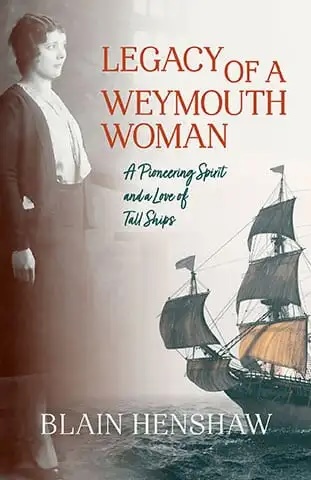
In his book, Blain says of his own mother: “She was a survivor, an innovator and an educator who, by example, taught me and my siblings the values of honesty, hard work, compassion and empathy, generosity, how to deal with adversity and, perhaps most important, how to have fun and enjoy life.”
The first half of the book tells of Lillian’s early life, when Weymouth was a bustling town of sailors and merchants. It had “several lumber mills, one pulp mill, a sash and door factory, a fish cannery, two carriage shops, two ship yards, five churches, two post offices, two schools, five hotels, a theatre and 30 mercantile establishments”
Today there are perhaps one-fifth of these still standing.
As a teenager, Lillian worked at the Goodwin Hotel (still operational today) and then later started, and ran, her own milliner’s shop. Inspired by other female writers of the time, and being a history buff with a good education, Lillian wrote of ships and sailors and local community events, eventually becoming a correspondent for local and provincial papers, and continuing to write throughout her life. Many excerpts of these are included in Blain’s book, providing a fascinating glimpse of life in those times. There are even some advertisements for her shop, with prices!
The later chapters are written more from the perspective of the author himself, growing up in Deep Brook and Waldec, where the family moved when Lillian married Thomas Russell Henshaw. The anecdotes are more personal, and intimate. Russell was a fur merchant but the market in furs was soon to collapse and money became tight. Despite this, thanks to her emphasis on the importance of education, she raised a family who have since then moved throughout Canada following diverse careers.
The author describes a childhood house freezing in winter, and without running water indoors. Yet the children were sent to school, and the jams and pickles were made. Homesteading was not a term; it was what was done. And the jams and pickles were shared with neighbours and those in need. His mother is shown to be a woman of compassion, generosity, and tenacity. In one story, he paints a vivid picture of Lillian using a gun left by a boarding gunsmith, who had cobbled it together from parts of two other guns. She used it to kill an errant rutting young moose, and later to scare off some neighbour’s cattle which had wandered into her precious garden.
He says of her: “Lillian May Doty exemplified not just the best of country women, but the best of women anywhere. It is so easy to overlook the accomplishments of ordinary people, those who go about their business and live their lives without occupying a large stage. Yet they form the backbone of families and communities with their resilience, resourcefulness and perseverance.”
This book is a tribute to Lillian’s legacy, and gives us a tantalizing glimpse into that generation, not so long ago, when people’s lives were different. Not easier, certainly, not necessarily happier, but different. Yet the experiences and priorities of people like Lillian have shaped our todays. Her decisions about education made her children what they are. Her tenacity and strength gave them strength and tenacity, and these shine through.
Written By:


Win Your Classroom Wishlist
Stay tuned for our next contest for Atlantic Canadian teachers! In the meantime, build a wishlist of books in the ABC collection that you can shop from any time! We'll let you know when it's time to share on social media with the hashtag #ReadAtlanticABC for a chance to win books from your list (up to $250 value).

