


The desires that have shaped Donald Andrus
Review of Donald Andrus: The Shape of Desire, by Ihor Holubizky, Pan Wendt, and Roslyn Rosenfeld
Art exhibitions have a fleeting life. Projects that take months, even years to develop, that can reflect decades of work by an artist, are on view for mere weeks. Most viewers experience them in just minutes. It is this ephemeral quality that makes a retrospective exhibition so special, and so daunting for the artist and organizing gallery.
“Retrospective” just implies a look back, of course, and in past decades the term was used for any exhibition that looked at a body of work over a period of time. Five years might have been enough in the 1950s to mount a “retrospective,” though these days anything under thirty years tends to be termed a “survey.” One feature of the gallery retrospective is the publication of a catalogue, once little more than a list accompanied by a few black-and-white photographs. Like the frequency of retrospectives, the catalogue has evolved with the times.
True retrospectives rarely happen more than once in an artist’s lifetime. Thus their special quality and their relative rarity. They are often accompanied by a book, offering readers the opportunity of a deep dive into an artist’s work, aided by the static medium of print. When delving into the monograph to a solo exhibition, the viewer becomes a reader, and their experience slows down, is repeatable.
Donald Andrus: The Shape of Desire is a true retrospective, an exhibition and a book that looks at more than 35 years of one artist’s production. The book, published by Goose Lane Editions, is a handsome hardcover that accompanies an exhibition at the Confederation Centre Art Gallery in Charlottetown.
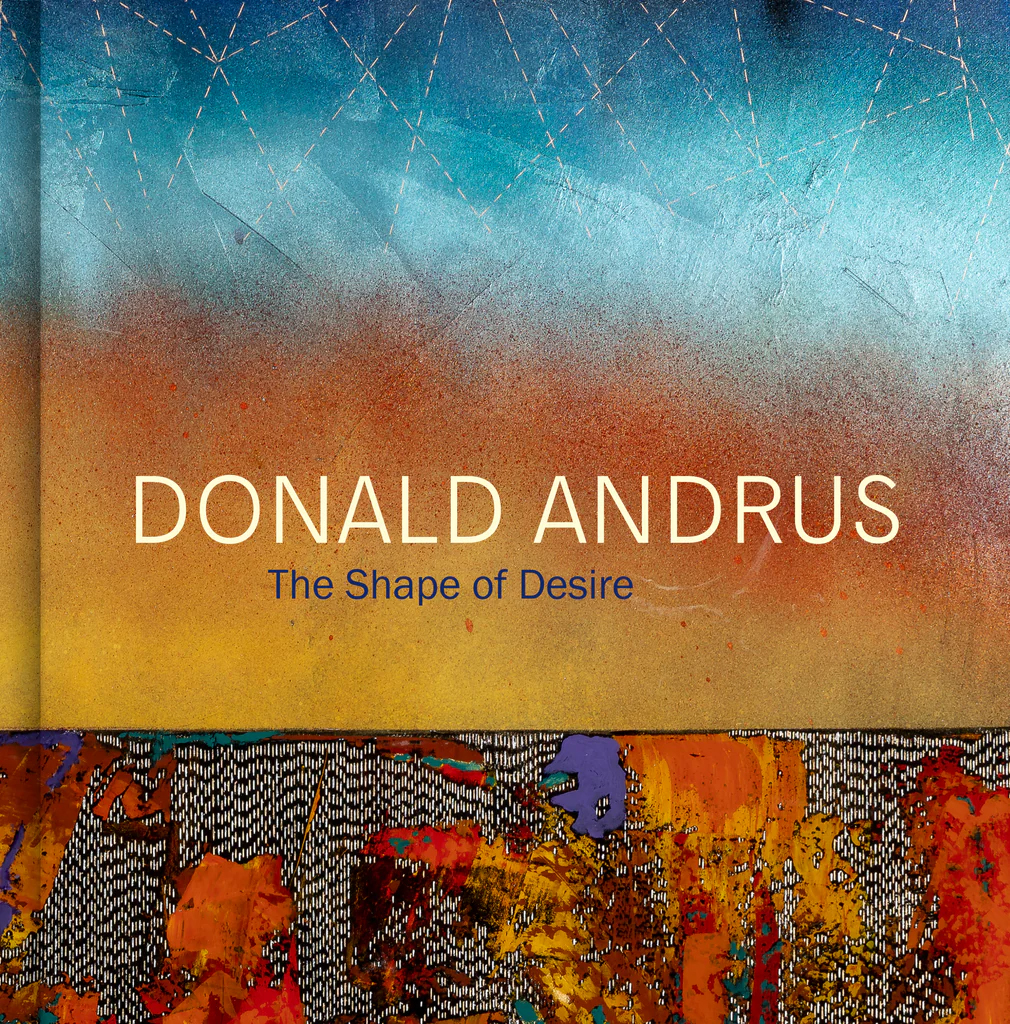
The team at Goose Lane is no stranger to publishing art books; indeed, over the past decade or so they have become one of the most active publishers of art books in the country. The Shape of Desire displays all the qualities that have earned them that distinction: sumptuous illustrations, well-edited texts, and beautiful design (in this case by Julie Scriver and Amy Batchelor). The book falls between the familiar “coffee table” tomes and the more user-friendly formats familiar from the world of fiction. At nine inches square the book is both comfortable to read and formatted to give ample space to the illustrations.
With an introduction and essay by the exhibition’s curator, Roslyn Rosenfeld, and additional essays by Ihor Holubizky, Pan Wendt, and the artist himself, the reader is provided with a holistic view of the artist’s career, one that, the texts make clear, has been anything but conventional.
Andrus had a long career as a curator and art historian. It was only in the late 1980s, just a decade before his early retirement from a professorship in art history at Concordia University in Montreal, that his art career, as a career rather than as an occasional activity, began. Rosenfeld carefully delineates the process by which Andrus reinvented himself as a maker of art, rather than a commentator on it. With his move to Prince Edward Island in 1998 he fully embraced painting as his vocation. Rosenfeld discusses the evolution of his work, which unfolded in a surge of related bodies of work, a spate of what Rosenfeld accurately describes as “furious activity.”
Where Rosenfeld takes a retrospective approach in her essay, looking at the whole breadth of Andrus’s career, Holobizky and Wendt choose to focus on recent bodies of work, bringing an element of specificity to the broad strokes of the retrospective exercise. Andrus himself dives deep into the origins and implications of a series of works that he calls the “field” series, a step-by-step description of how he followed an idea through a series of works over years.
While Donald Andrus: The Shape of Desire will outlast the exhibition it chronicles, its strength is as a record of an event and of a career, providing context to the work which will be dispersed at the end of the show, perhaps never to be brought together again, except as it is in these pages. Art may last, but exhibitions pass. All the more reason to be grateful that galleries and publishers continue to collaborate on books such as this.
-30-
Ray Cronin is the curator of Canadian Art at the Beaverbrook Art Gallery in Fredericton. From 2001 to 2015, he was a curator and director and CEO at the Art Gallery of Nova Scotia. Cronin has written about visual arts for more than two decades and is the author of Our Maud: The Art, Life and Legacy of Maud Lewis and Alex Colville: Art and Life.
Written By:


Win Your Classroom Wishlist
Stay tuned for our next contest for Atlantic Canadian teachers! In the meantime, build a wishlist of books in the ABC collection that you can shop from any time! We'll let you know when it's time to share on social media with the hashtag #ReadAtlanticABC for a chance to win books from your list (up to $250 value).

